Encountering James Baldwin’s The Evidence of Things Not Seen in Christina Sharpe’s Ordinary Notes
This Reading Notes piece begins with an encounter with an image of a book in another book that has been for me a prompt to more reading. The image of the book is James Baldwin’s The Evidence of Things Not Seen and it is nested in Christina Sharpe’s Ordinary Notes.[i] Here I discuss how this encounter has led me to pursue a reading journey to critically examine the social and political transformations that shaped my hometown of Atlanta in the 1970s.
I first read Sharpe’s formally complex and affectively powerful book when it was published in 2023, and since then, I have twice taught it in my gender studies graduate seminar on feminist interdisciplinary histories and methods. In the graduate seminar, I asked students to prepare for our discussion of Ordinary Notes by selecting 2 or 3 notes to share with the seminar. This was a simple pedagogical exercise that worked well in practice by allowing everyone to participate in leading the seminar discussion. The exercise also meant that our entry points to the text were multiple and wide-ranging.
Sharpe’s collection of notes is numbered from 1-248 and the notes vary in length, modality, and tone: some go on for many pages, others are comprised of a single sentence; some are textual, others are visual, still others mix the visual and verbal; and the notes range across affective registers, from tenderness to rage, joy to horror, and more in between. One of the many pedagogical affordances of Ordinary Notes is how it demonstrates the importance of regard, a keyword in Sharpe’s critical vocabulary, for the small details of everyday Black life and for what Sharpe calls “beauty as a method,” even as it also documents and critiques larger and enduring structures of white supremacy and anti-Blackness. By selecting notes to share with the seminar, I wanted students to annotate Sharpe’s own annotations, and this process helped capture the meta-process I try to enact in my pedagogy, of close reading and drawing connections between texts.
I also selected several notes to annotate and share with the class. It seemed important that I do this along with my students, even though, or indeed because, we are at different points in our scholarly journeys. There was one note I both did and did not to want to share. The reason for my hesitation was that sharing it would require me to reveal some personal history to explain its significance to me. That note is Note 69, in which Sharpe writes about her family in one of the many sentences I love in Ordinary Notes, “We had an elaborate language of book giving.” The book Sharpe selects to demonstrate this elaborate language of book giving is what appears to be the first edition of the hardcover of Baldwin’s The Evidence of Things Not Seen, first published in 1985. On the blank left-hand page opposite the title is the elegantly penned inscription, “to Tina with love, from Mom,” with what looks like a drawing of a bee between “to Tina” and “with love.”[ii] At the very bottom of the page, the date is also neatly inscribed: December 25, 1985. Reading this note has always pierced me, suggesting not only Roland Barthes’s notion of the punctum, as that aspect of a photographic image that reaches out from the flatness of the page to puncture the viewer, but also Sharpe’s critique of what Barthes doesn’t see (the everyday beauty of Black life, the violence of white supremacy) in his analysis of photographic images in Camera Lucida, a book Sharpe engages with and takes to task in Ordinary Notes.
This page pierces me each time I read Sharpe’s book. In annotating the page, I am unsure what the punctum is. Is it Sharpe’s mother’s neat cursive writing, so different from my own mother’s messy scrawl? The playful bee? The book’s title? Knowledge of what the book is about?
My mother also gifted her three daughters a love of reading and books from a young age. “As a life-long lover of reading,” I wrote in her obituary in 2017, “she managed the Reading Is Fundamental (RIF) program for the Atlanta Public Schools for several years” in the 1970s. We had piles of children’s books at our house that she would bring to schools throughout the city of Atlanta. Children could choose their own book to bring home to read. I still have in my office one of the RIF posters, which my mother had framed and hung in her library, a colorful child’s drawing of a girl jubilantly riding a horse with the horse’s head and body drawn as books. The poster now hangs in my university office. In a selfie I took for a photo I frequently use as a headshot, that poster is in the frame just behind me—"reading is fundamental” hovers over me as a lesson I first learned from my mother and that still informs everything I do today.
I would not claim, however, that our family had an elaborate language of book giving in the way Sharpe so movingly depicts in Ordinary Notes. This is one reason I was unsure about sharing this note with my class, because I didn’t want to claim that my mother was like Sharpe’s mother in a way that would flatten the many differences between them, between us. And it is those differences I am struck by when I encounter this page in Sharpe’s book. Indeed, it is such differences—and the racism that structures them—that I have come to realize is the punctum in my encounter with this image, the evidence of things not seen of my growing up in Atlanta in the 1970s.
My mother was the daughter of Greek immigrants and grew up in Chicago. As with many second-generation immigrants, she was very much invested in education but also what I would call a politics of respectability. She studied childhood development at the University of Illinois and that’s where she met my father who was studying architecture. We moved from the Midwest to Atlanta in the early 1970s. My father was the architect who designed the Avondale MARTA station, which was the original eastern terminus of the East-West line. To take advantage of a building boom in Atlanta in the 1970s, he opened a branch of a Milwaukee-based architectural firm there, before eventually heading his own firm. As the note in Sharpe’s book spurs my reading, I realize too that architecture structures, and is a kind of inheritance, of my experience growing up in Atlanta.
In the photo of The Evidence of Things Not Seen in Ordinary Notes, Baldwin’s name is not on the title page, and Sharpe doesn’t say anything about the book itself in her notes. But I immediately know the book is about the missing and murdered Black children in Atlanta in the late 1970s and early 1980s. Seeing this book open on the title page reminds me of that time when Atlanta’s Black community lived in terror. Baldwin went to Atlanta in 1981 to report on the story for Playboy magazine, and the book based on that reporting was first published in 1985. I did not read the book when it was first published—at the time Sharpe’s mother gifted it to her daughter—but only later, in the early 1990s, after I had graduated from college and was living in Seattle and working at Elliott Bay Book Company.
My mother worked briefly with Camille Bell, whose son Yusuf was one of the first children who went missing and was later found dead. Camille Bell features in Baldwin’s book because she became a community organizer in the wake of her son’s death, motivated by grief and rage that the city was not doing enough to find the killer and protect Black children. I know these things by virtue of my family’s proximity to, but also distance from, this terror. This is one of the lessons in Sharpe’s book about how white supremacy and racism operate, and it is also, of course, the lesson of Baldwin’s book, incorporated without commentary about its specific content but as an example of Sharpe’s mother’s “elaborate language of book giving” and as an indication of the centrality in Sharpe’s work of the evidence of things not seen. Baldwin’s title references a Bible verse, “Now faith is the substance of things hoped for, the evidence of things not seen” (Hebrews 11:1), and his use of the phrase for his reporting on what he calls “this matter of Atlanta” suggests both the ongoing terror of the past in the present and a hope for a different future that might emerge from a community united in what Baldwin calls “our only real responsibility,” the task of raising a child.
Encountering The Evidence of Things Not Seen in Ordinary Notes spurs me to look back to what I have come to think of as the different tracks of white and Black Atlanta in the 1970s. These tracks are literal—Atlanta was founded as a railroad junction, one of its first names was Terminus, and the MARTA transit system that brought my family to Atlanta in the 1970s was comprised of two intersecting train lines (East-West and North-South). Moving in the opposite direction of many Black families who migrated from the South to the North for economic opportunity and the chance for a better life, my family migrated from North to South. We were participants in and beneficiaries of the building boom that led to gentrification and the destruction of Black neighborhoods and communities. The original MARTA lines would link the white suburbs of the North to the airport, which would become the busiest in the world, and Black neighborhoods in the South and the historically Black colleges in the West with the King Center and the city of Decatur in the East. We moved into a house in the upper-middle-class neighborhood of Druid Hills near Emory University which bordered a historically Jewish neighborhood where many of my high school friends lived. Although the public high school I attended was progressive, and several of my classmates were children of Emory professors, many people in Druid Hills fought to ensure that the MARTA line did not cut through this historically white neighborhood.
The image of Baldwin’s book in Sharpe’s note has propelled me to read more. I began with the original essay Baldwin wrote for Playboy in 1981, which then led me to read about the Black editor at Playboy, Walter Lowe Jr., who asked Baldwin to write about Atlanta and accompanied him on his reporting there.[iii] I also read a moving essay by Lowe’s daughter, Holly Lowe Jones, who writes about discovering Baldwin’s dedication to her father when she happened to pick up The Evidence of Things Not Seen in 1996 “as an 18-year old, Black, young woman, desperately searching for answers about race, justice, and inequality that were clearly not going to be found where I grew up in Northwest Indiana.”[iv] This, in turn, led me to many other literary critical accounts of what would be Baldwin’s last book, many of which note the mostly negative critical reception to the book, including, for example, Caryl Phillips’s damning assessment that it seemed “to have been, from the beginning, badly conceived. As it proceeds it feels increasingly padded with irrelevant autobiographical asides which continually lead the reader away from, rather than towards, the subject matter under consideration.”[v] I first read about Phillips’s critique of Baldwin’s book in Bill Schwarz’s fascinating essay in which he reads The Evidence of Things Not Seen with Chinua Achebe’s novel Anthills of the Savannah, both of which, Schwarz argues, “share a significant preoccupation with form.”[vi] I appreciate that Schwarz pushes back on Phillips’s dismissive reading of Baldwin’s book by pointing out the significance of Baldwin’s struggle to find a form adequate to illuminate what Schwarz calls “the unseen infiltration of the reflexes of terror into the psyche of the nation.”[vii] I would add that Baldwin leads the reader both away from and toward the subject matter—the missing and murdered children in Atlanta—because this formalizes an approach to what Baldwin renders as the evidence of things not seen.
Schwarz’s essay on Baldwin and Achebe also begins with a reflection on reading. He writes, “Old reading habits can calcify the very practice of reading, working to screen what history requires us to see. And then, as if from nowhere, by a curious conjunction of the personal and the political, our reading selves are hit by an air-pocket of turbulence, and we are jolted out of the familiar into the unfamiliar, such that we are defamiliarized from our own selves. In this lies the promise of reading.”[viii] Schwarz notes that he came to Baldwin’s book “by way of a complex process of indirection. An important impetus lay in my reading Chinua Achebe, and then moving to Baldwin.” His essay attempts to “reconstruct something of this journey.”[ix]
Schwarz’s description of the “promise of reading” as being “jolted out of the familiar into the unfamiliar, such that we are defamiliarized from our selves” is what my work seeks to document too. Encountering Baldwin’s The Evidence of Things Not Seen in Sharpe’s Ordinary Notes creates a “curious conjunction of the personal and the political” and “an air-pocket of turbulence” that becomes an opening for me to see what was unseeable in the everyday habitations of growing up in a racist and segregated city. This is only the beginning of my reading journey. In my next post, I will discuss further the architecture that shaped Atlanta (and me) in the 1970s and 1980s by considering the many explicit references to Atlanta’s architecture in Baldwin’s work. These references appear more prominently in Baldwin’s essay in Playboy than in the book about the missing and murdered children in Atlanta. Indeed, the essay was titled “Atlanta: The Evidence of Things Not Seen,” emphasizing that the specificity of place matters in Baldwin’s reporting from Atlanta. As I will show, Baldwin’s critique of Atlanta’s architecture is as an important precursor and counternarrative to Fredric Jameson’s later analysis of the postmodern “hyperspaces” that he delineates as a new architectural and cultural form that transformed urban spaces in the US in the 1970s.
Notes
[i] Christina Sharpe, Ordinary Notes (New York: Farrar, Straus and Giroux, 2023): 110; and James Baldwin, The Evidence of Things Not Seen (New York: Holt, Rinehart and Winston, 1985).
[ii] Sharpe, Ordinary Notes, 110.
[iii] Walter Lowe Jr. writes about how he contacted Baldwin in France to ask him if he would write a story on the missing and murdered children in Atlanta for Playboy. According to Lowe, Baldwin “was silent for a long time, then sighed deeply and said, ‘I was just reading about the murders in the New York Times when you called. I find the whole thing very disturbing. Very disturbing. I quite agree with you that there’s much more there than anyone is willing to discuss and that someone should say something. Perhaps your call is what the Turks call kismet,’” “Moment of Truth in Atlanta,” James Baldwin Review, vol. 9 (2023): 140.
[iv] Holly Lowe Jones, “The View from the Riverbank: James Baldwin and The Evidence of Things Not Seen,” James Baldwin Review, vol. 9 (2023): 120.
[v] Caryl Phillips, “James Baldwin. The Price of the Ticket,” in Colour Me English: Reflections on Migration and Belonging (London, Harvill Secker, London, 2011): 244.
[vi] Bill Schwarz, “After Decolonization, After Civil Rights,” James Baldwin Review, vol. 1 (2015): 46.
[vii] Schwarz, “After Decolonization, After Civil Rights,” 57.
[viii] Schwarz, “After Decolonization, After Civil Rights,” 42.
[ix] Schwarz, “After Decolonization, After Civil Rights,” 42.
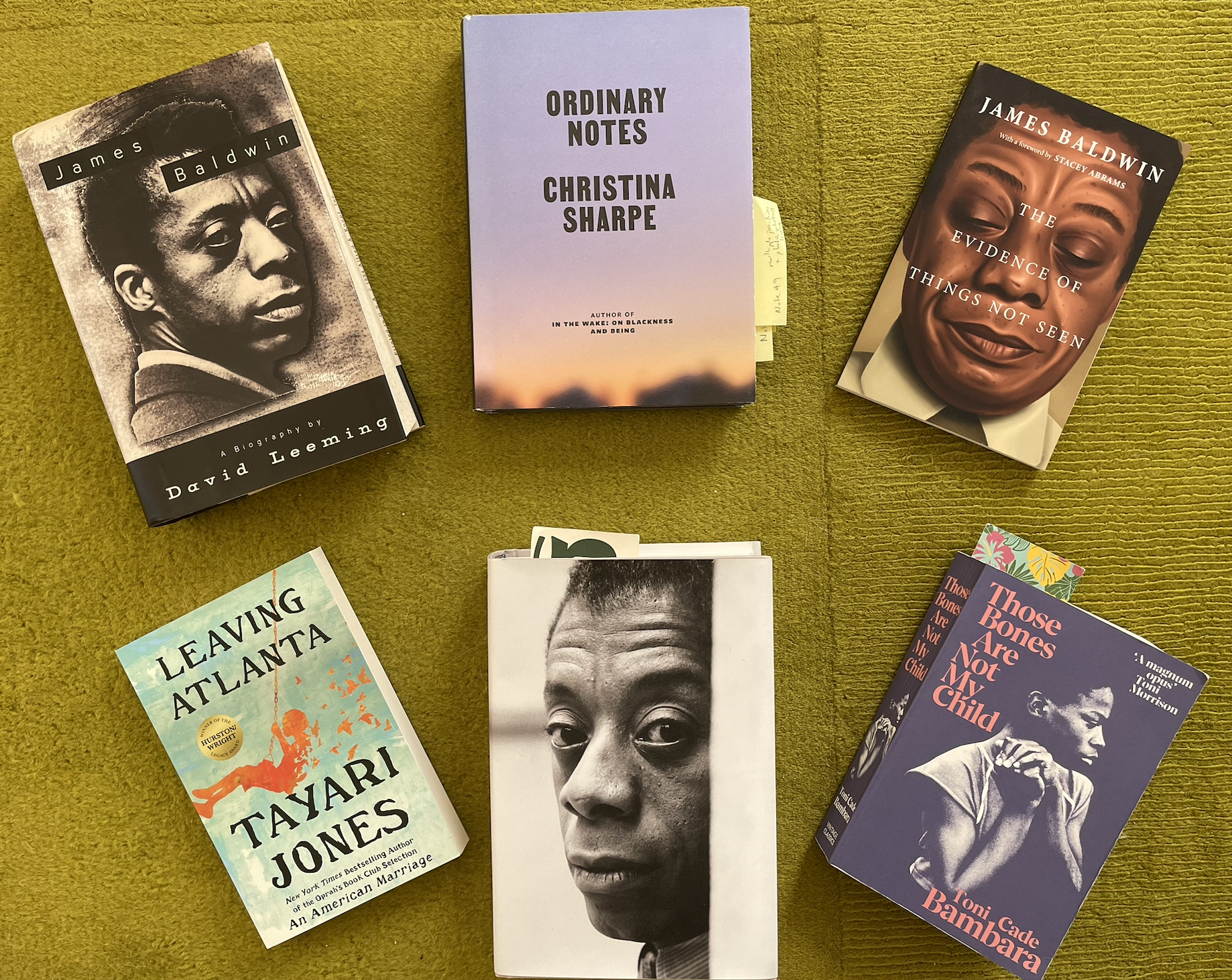
Photo depicting books I have been reading for this Reading Notes blog post and for future posts. Clockwise from top left, displayed on a lime green carpet: David Leeming’s James Baldwin: A Biography, Christina Sharpe’sOrdinary Notes, James Baldwin’s The Evidence of Things Not Seen, Toni Cade Bambara’s Those Bones Are Not My Child, Nicholas Boggs’s Baldwin: A Love Story, and Tayari Jones’s Leaving Atlanta. The Evidence of Things Not Seen is the 2023 reissue with a foreword by Stacey Abrams and an illustration of Baldwin by artist Alexis Eke based on a photograph by Anthony Barboza. In this image, Baldwin looks down and we can’t see his eyes. The two Baldwin biographies have photographs of Baldwin looking directly at the camera and at us, the readers. The photograph for the Leeming biography is credited as UPI/Bettman and is incorporated into a collage by Archie Ferguson. The Boggs biography includes only the photograph of Baldwin by David Gahr with a white background and no text at all. Sharpe’s Ordinary Notes is the hardcover with a photograph by the author of a bluish-purple sky above a slight glow of sun rising or setting over a blurry landscape. Bambara’s novel has a cover photograph of a young Black person, which is a detail from an image by Bromberger Hoover. The credit for the photo on the back cover also states, “The picture does not depict any character within the book but is an expression of the innocence and defiance of a disenfranchised community.” The cover of Jones’s novel was designed by Jaya Miceli and is an orange silhouette-like illustration of a child on a swing with birds flying out from the child’s body.