James Baldwin, “this matter of Atlanta,” and the Architecture of Racism
This Reading Notes post continues from my last post on encountering James Baldwin’s Evidence of Things Not Seen in Christina Sharpe’s Ordinary Notes. In this post, I discuss further the architecture that shaped Atlanta (and me) in the 1970s and 1980s by considering how James Baldwin explicitly references Atlanta’s architecture in his writing about the missing and murdered children in Atlanta. I return to the essay that Baldwin wrote for Playboy about the case that was published in December 1981. Although published after the arrest of Wayne Williams and just before his trial, Baldwin does not mention Williams in the article, likely because most of the reporting and writing had been done before Williams was arrested. The book, published four years later, does grapple extensively with the figure of Wayne Willams and his case, expressing some skepticism that Williams is responsible, or solely responsible, for the murders. Baldwin reiterates several times in the book that Williams was only charged with and convicted of two murders, and those were of young adult men not of any of the children on the “official” list. Baldwin writes that, “it does not demand a suspension of judgment to realize that a murdered man is not a murdered child,” and he argues that “the connection of the two murders with the previous twenty-six has absolutely no legal validity.”[1] Baldwin’s skepticism echoes the position of many in the Black community in Atlanta, including Camille Bell, the mother of murdered child Yusuf Bell and founder of the Committee to Stop Children’s Murders (STOP), who Baldwin acknowledges was the first to challenge “what she took to be the official indifference to the slaughter of the children, which connected, for her, with the economic status of the victims.”[2]
In what follows, I move back from The Evidence of Things Not Seen and its focus on the aftermath of the case to consider Baldwin’s earlier article, written in the immediacy of his visit to Atlanta in the spring of 1981, and which frames the story of the missing and murdered children within a larger story of Atlanta’s booming urban development in the 1970s. I argue that one key features of the article is Baldwin’s attention to what I am calling the architecture of racism that transformed Atlanta’s urban landscape. As Baldwin recognizes, newly built office towers, hotels, and sports and commercial complexes destroyed or crowded out many of Atlanta’s inner city Black neighborhoods. As in my earlier post, I situate my own family’s migration to Atlanta as part of this building boom, with my architect father first arriving in Atlanta as designer for the Avondale MARTA station in the early 1970s. This is architecture as a form of structural violence that has repercussions into the present for both white and Black Atlantans.
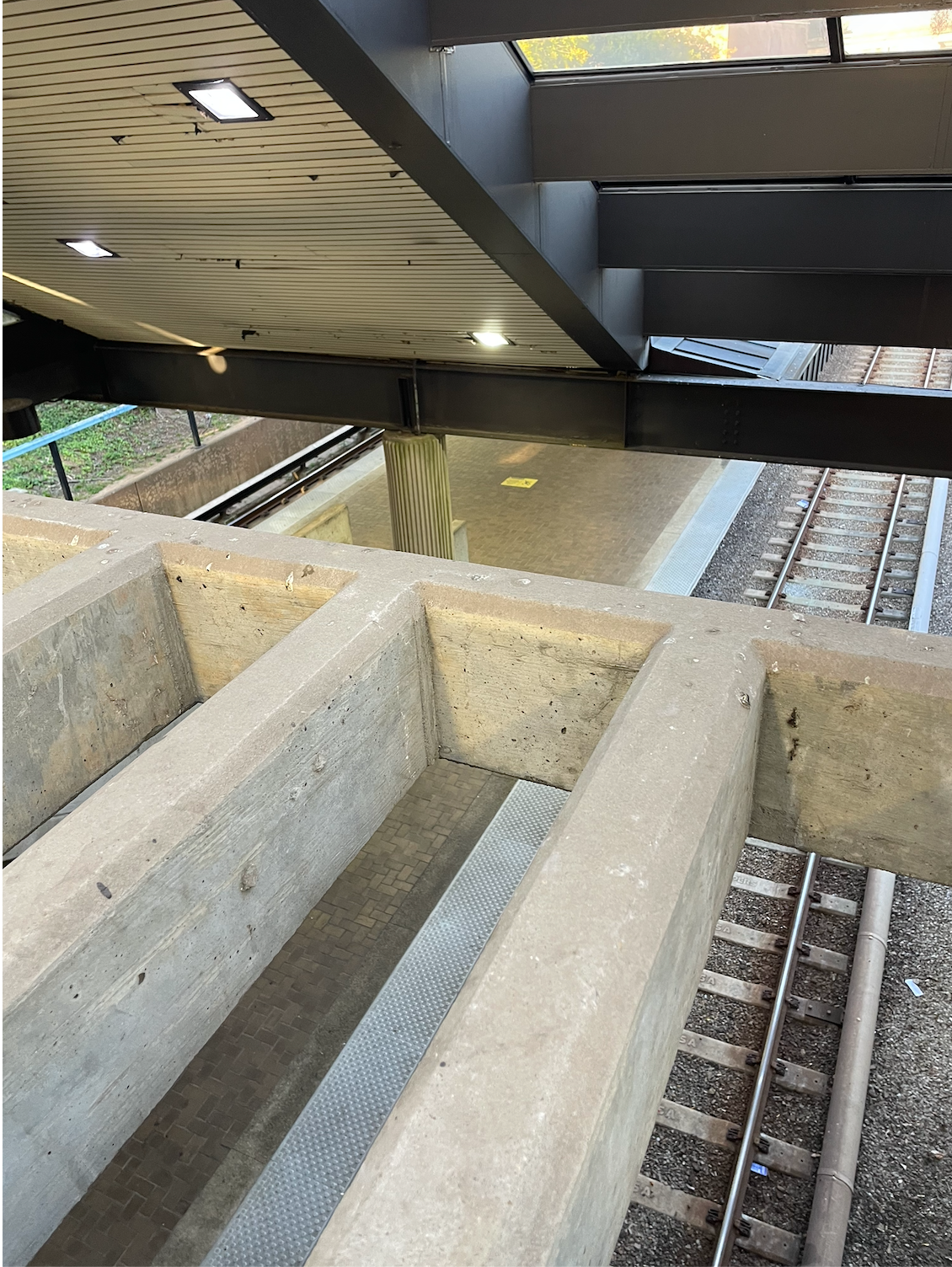
Avondale Marta Station
Photograph from above looking down on the tracks and concourse of the Avondale Marta station. In the foreground is a poured concrete grid and above is a slanted metal roof and skylight with metal louvres. Photo taken by the author on a visit to Atlanta in October 2025.
The first thing to note about Baldwin’s Playboy essay is that it is called “Atlanta: The Evidence of Things Not Seen,” emphasizing that the specificity of the place matters to the story Baldwin tells.[3] When the essay is transformed into a book, “Atlanta” will disappear from the title, suggesting a more diffuse—some critics will say, less focused—story about racism and violence. Baldwin begins his article with what he calls the gift and responsibility of a child’s life and his own uncertainty in knowing how to begin in “this matter of Atlanta.” He writes, “Human life, and especially a child’s life, is our most important gift, our only real responsibility, and is more sacred than any temple or any doctrine, anywhere. In this matter of Atlanta, then, one scarcely knows how to begin—and that is because, abjectly, profoundly, one doesn’t wish to begin.”
Haltingly, then, Baldwin turns his attention to Atlanta and its image of itself as a “city too busy to hate,” a phrase first used by Mayor William B. Hartsfield in the early 1960s and a motto that some saw affirmed with the election of the city’s first Black mayor, Maynard Jackson, in 1974.[4] Baldwin, however, will see the horror behind Atlanta’s image of itself in the realization that a temple (business) and doctrine (capitalism) are in fact more important than some children’s lives. Baldwin is skeptical of Atlanta’s claims of being “too busy to hate”: “But it is important to point out that the only reason Atlanta is stuck with such a title is that it is the crown jewel of the New South.” He then immediately challenges Atlanta’s sense of itself as somehow new, intoning, “Lord. The New South. Do not come down here looking for it. Forget everything you may have heard, or may wish to believe, concerning the New South. There is no New South.”
As Baldwin sees it, there is no New South, but there are many new buildings. Reading Baldwin’s essay in 2026 I am surprised to find references to Atlanta’s architecture, new buildings not so much replacing but integrated into an older plantation aesthetics and politics, which Baldwin calls “the Big House”: “Squares, tubes, vials and bubbles assault the patient sky, ruthlessly connected to the sweeping lawns and steps and columns and verandas of the Big House, immortalized, like Lot’s wife, behind the Big Gate.” He describes how the new buildings have been built not for the locals, but rather to attract conventioneers, which “are the lifeblood of the city and do not, after all, stay here very long—not at a stretch, anyway, which may be why they always seem so cheerful.”
Baldwin doesn’t explicitly mention the architect John Portman in the essay, but many of the “squares, tubes, vials and bubbles assault[ing] the patient sky” are Portman’s handiwork, the geometric shapes of the postmodern “hyperspaces” Fredric Jameson will later delineate in an essay in The New Left Review in 1984 as the architectural sign of the new cultural logic of late capitalism that transformed urban spaces in the US in the 1970s.[5] In a response also in The New Left Review to what he sees as Jameson’s totalizing narrative of postmodernism, Mike Davis argues that “Jameson’s postmodernism tends to homogenize the details of the contemporary landscape, to subsume under a master concept too many contradictory phenomena which, though undoubtedly visible in the same chronological moment, are nonetheless separated in their true temporalities.”[6] Crucially, this is also Baldwin’s point concerning the architecture of the New South in his essay written before either Jameson’s or Davis’s essays.
According to Davis, what is missing from Jameson’s homogenizing move is an analysis of what Davis calls “the decisive role of urban counter-insurgency” against the urban rebellions of the 1960s, whereby “a racist, as well as class, imperative of spatial separation has been paramount in urban development. No wonder, then,” Davis continues, “that the contemporary inner city resembles nothing so much as the classical colonial city, with the towers of the white rulers and colons militarily set off from the casbah or indigenous city.”[7] Davis explains that the “prototype of Portmanesque space—the spaceship elevators, multi-storey atrium lobby, and so on—was the Hyatt-Regency built in 1967 in Atlanta’s Peachtree Center,” and he quotes Carl Abbot’s The New Urban America (1983) describing Downtown Atlanta, anchored by Portman’s Peachtree Center, as rising above “its surrounding city like a walled fortress from another age.”[8]
This is also the sense of spatial separation that Baldwin captures in his essay about the missing and murdered children in Atlanta. Baldwin notes the direct and indirect connections between Atlanta’s architecture and the child murders. He mentions the Omni, a massive multi-use structure built in the 1970s (though not designed by Portman), and he succinctly captures the imperative of spatial separation at work in the design. “One of Atlanta’s architectural triumphs is called the Omni,” Baldwin writes. “The name is scarcely more ambitious than the place, which is a kind of frozen, enclosed suburb. It is about five minutes away from a sprawling, poor-black neighborhood called Vine City. A child can walk here from his home in less than five minutes; some of the murdered children were last seen in this place.”[9]
Peachtree Center and the Omni are spaces I knew well growing up: my father’s architectural firm’s office was in Peachtree Center, and his firm bought season tickets to take clients to watch the Atlanta Flames, the city’s newly arrived ice hockey franchise that played its games at the Omni, along with the Atlanta Hawks, the city’s basketball team that had arrived from St. Louis in 1968. The Flames were the first hockey franchise in the South, and I realize now that my family arrived the same year as this quintessentially white sport (if now somewhat less so) was transplanted to the South and housed in the arena built on “a mass of railroad tracks in a desolate area of downtown.”[10] In 1997 as the complex was about to be razed, Tom Cousins, the developer who built the Omni, described the downtown area where the Omni was built in the racist, colonialist discourse of urban renewal, as “an open no-man's land” and as “a real raunchy part of town, very unsafe and very unsavory.”[11]
Always a tomboy and sports lover, I soon became a hockey fan and frequently attended Flames games at the Omni. In recalling the place of the Omni in my life, I am confronted by what such memories conveniently cover over—the evidence not seen of the conditions that made my experiences growing up so different from those of other children in Atlanta. The seeming innocence of attending a hockey game as a memory of my childhood now sits uncomfortably in the present next to other memories—of poor Black children being murdered in proximity to, perhaps even targeted in the same spaces, where I enjoyed a sports spectacle made possible by a development built with the intention of displacing Black neighborhoods.
This is the architecture of racism Baldwin diagnoses in “Atlanta: The Evidence of Things Not Seen.” He writes of the Omni, “what a slap in the face, what an insult, to place this Roman excrescence in the very path of the wretched, who must daily go through it or find a way around it. Such structures are defended by those responsible for them as ultimately benefiting the poor by breathing new economic life into the community or, more simply, by creating new jobs. This, alas, is nonsense.”[12] Baldwin understands that the Black youth of Atlanta do not dream of being a “new serving class” and he goes so far as to insist that the problem is worse even than this. He alludes to the threat of Black genocide, remarking, “But if the sinking Western world has its way with us now, there will be no children to raise: raise to what, and by what standard?” He again finds himself at a loss, scarcely knowing how to continue, yet insisting on the ongoingness of our inquiries, “[t]his is the subject of another essay, but it is also the question that vexes and, in some way, begins to unite all of black Atlanta.”[13]
Here Baldwin demonstrates that the question that vexes might also be that which brings people together. Baldwin ends his essay by quoting his friend Toni Morrison who tells him one person can’t raise a child; rather, it takes a village, and “if the race is to survive…it has to take care of its own.”[14] Baldwin ends then not with white Atlanta’s image of itself as a city too busy to hate, but with an enduring image of Black survival, of a community united in “our only real responsibility,” the task of raising a child. This brings us back to Baldwin’s essay’s title, not “Atlanta: The City Too Busy to Hate” but “Atlanta: The Evidence of Things Not Seen,” referencing both the racism shaping Atlanta’s built environment and the ongoing struggle for a better future for all children.
For my next Reading Notes post, I turn from Baldwin’s writings about Atlanta to Toni Cade Bambara’s immense and powerful novel Those Bones Are Not My Child based on the case of the missing and murdered children in Atlanta, which was Bambara’s home in the late 1970s and early 1980s. Toni Morrison also figures here: she will edit Bambara’s massive manuscript and publish the novel in 1999, four years after Bambara’s death.
Notes
[1] James Baldwin, The Evidence of Things Not Seen (New York: Henry Holt and Company, 1985 [2023]), 13.
[2] Baldwin, The Evidence of Things Not Seen, 49.
[3] James Baldwin, “Atlanta: The Evidence of Things Not Seen,” Playboy (December 1981). When I searched for this essay online, I found it as a digitized item in the Maynard Jackson Mayoral Administrative Records collection at the Atlanta University Center Robert W. Woodruff Library. Playboy editor Kevin Cook sent the article to Maynard Jackson in November 1981, noting, “We believe this might be of interest to you and would welcome your comment.”
[4] For an excellent presentation on “Atlanta’s carefully managed image of racial moderation,” see “Trouble the Land: The City Too Busy to Hate” from the editors of Southern Spaces at Emory University, May 12, 2026. Available at https://southernspaces.org/2026/trouble-land-city-too-busy-hate/.
[5] Fredric Jameson, “Postmodernism, or The Cultural Logic of Late Capitalism,” New Left Review 146 (July-August 1984), 53-92. In “Moment of Truth in Atlanta,” Walter Lowe Jr., the editor at Playboy who hired Baldwin for the assignment and accompanied him on his reporting in Atlanta, notes that when he first contacted Baldwin in France, Baldwin asked about accommodations in Atlanta. Lowe writes that Baldwin “groaned” when he told him Playboy would put him up in “a nice room at the Peachtree Plaza Hotel,” “Moment of Truth in Atlanta,” James Baldwin Review, vol. 9 (2023), 140. The Peachtree Plaza Hotel was designed by John Portman.
[6] Mike Davis, “Urban Renaissance and the Spirit of Postmodernism,” New Left Review 151 (May-June 1985), 107.
[7] Davis, “Urban Renaissance and the Spirit of Postmodern,” 111.
[8] Davis, “Urban Renaissance and the Spirit of Postmodern,” 112. Davis cites Carl Abbot, The New Urban America (Chapel Hill: University of North Carolina Press, 1983), 143.
[9] Baldwin, “Atlanta: The Evidence of Things Not Seen.”
[10] Paul Newberry, “Omni farewell: ‘It’s like somebody is taking my house away from me,’” Associated Press (April 27, 1997).
[11] Newberry, “Omni farewell.”
[12] Baldwin, “Atlanta: The Evidence of Things Not Seen.”
[13] Baldwin, “Atlanta: The Evidence of Things Not Seen.”
[14] Baldwin, “Atlanta: The Evidence of Things Not Seen.”